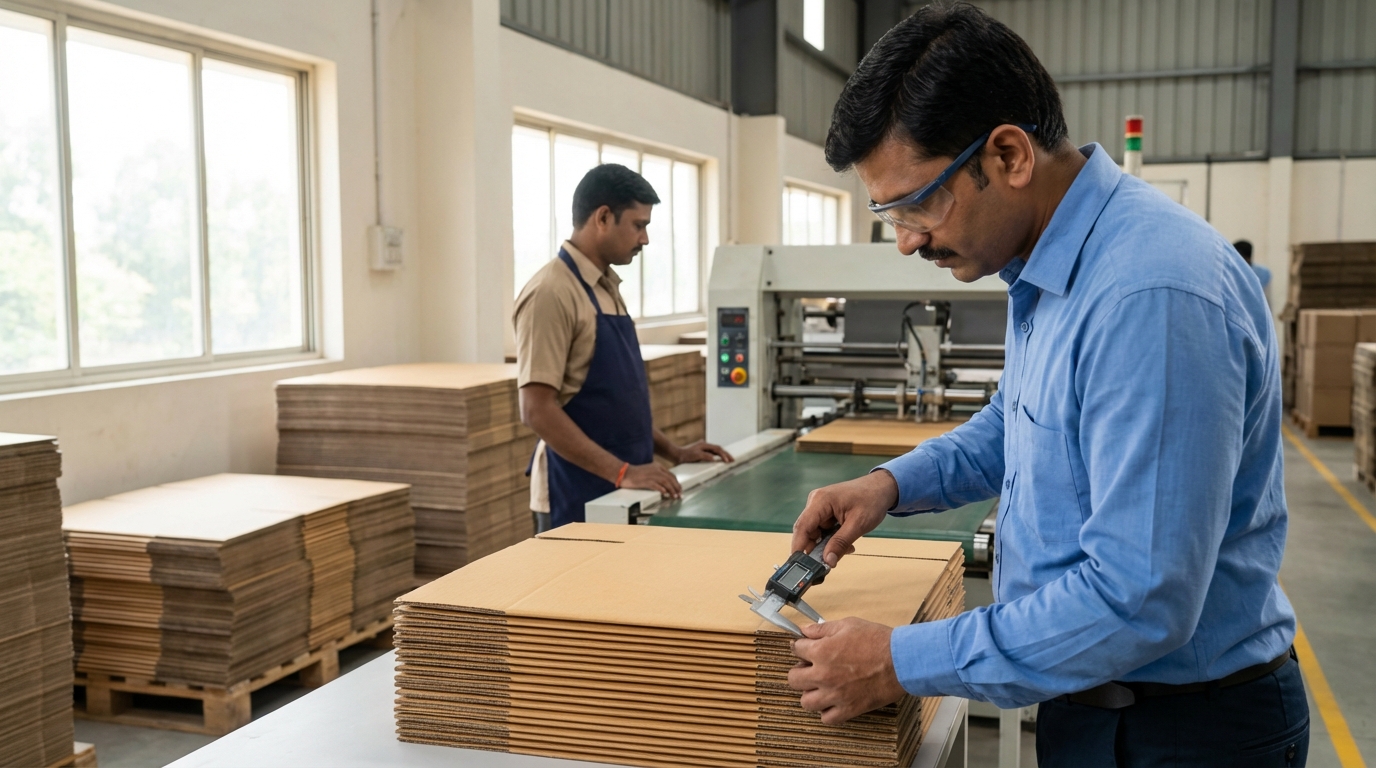
Understanding Box Strength and Compression Testing
Learn how to calculate and optimize box compression strength (BCT) to ensure your packaging protects products during shipping and storage.
Box strength determines whether your packaging will protect products during shipping and storage. Let's understand the basics without getting too technical.
What is Box Compression Strength (BCT)?
BCT measures how much weight a box can handle when stacked. Think of it like this: if you stack boxes in a warehouse, the bottom boxes need to support everything above them without crushing.
Why BCT Matters:
- Prevents product damage during shipping
- Allows safe warehouse stacking
- Reduces customer complaints
- Meets shipping carrier requirements
Factors That Affect BCT:
- Paper quality (GSM and type)
- Box dimensions (larger = weaker)
- Number of layers (3-ply, 5-ply, 7-ply)
- Flute type (A, B, C, E, BC flutes)
- Environmental conditions (humidity weakens boxes)
Understanding Paper Layers and Flutes
Box Layers (Ply):
- 3-Ply (Single Wall): Standard boxes, moderate strength
- 5-Ply (Double Wall): Heavy-duty boxes, high strength
- 7-Ply (Triple Wall): Industrial boxes, maximum strength
Flute Types:
- E-Flute: Thin, great for printing, light products
- B-Flute: Standard strength, most common
- C-Flute: Good cushioning, fragile items
- BC-Flute: Double wall, heavy products
Rule of thumb: More layers + larger flutes = stronger boxes (but more expensive)
Simple BCT Guidelines
You don't need complex formulas. Here are practical guidelines:
Light Products (< 5 kg):
- 3-Ply with 120-150 GSM paper
- BCT requirement: ~150-200 kg
Medium Products (5-15 kg):
- 3-Ply with 150-180 GSM paper
- BCT requirement: ~250-350 kg
Heavy Products (15-30 kg):
- 5-Ply with 180-220 GSM paper
- BCT requirement: ~400-600 kg
Extra Heavy (> 30 kg):
- 5-Ply or 7-Ply with 220+ GSM paper
- BCT requirement: ~700+ kg
Stacking Strength Calculation
Basic Formula: Required BCT = (Product Weight × Stacking Height × Safety Factor)
Example:
- Product weight: 10 kg
- Stacking height: 6 boxes high
- Safety factor: 5 (industry standard)
- Required BCT = 10 × 6 × 5 = 300 kg
Always add a safety factor of 4-6 to account for humidity, handling, and storage time
Testing Your Boxes
Professional Testing: Use a BCT machine at testing labs. Boxes are compressed until they collapse. This gives you exact BCT values.
Quick Field Test (Visual Inspection):
- Stack 5-6 loaded boxes
- Leave for 24 hours
- Check bottom box for bulging or damage
- If damaged, your BCT is too low
Improving Box Strength
Without Increasing Cost Much:
- Optimize box dimensions (smaller = stronger)
- Use correct flute type for the application
- Ensure proper storage (keep boxes dry)
- Minimize perforation and cuts
When You Need More Strength:
- Upgrade paper GSM
- Add more layers (3-ply to 5-ply)
- Use virgin kraft instead of recycled paper
- Add corner posts or internal supports
Common Strength Problems
Problem: Boxes collapse during stacking Solution: Increase BCT by upgrading paper or adding layers
Problem: Boxes get crushed during shipping Solution: Check if carrier requirements are met, improve cushioning
Problem: Boxes weaken in humid conditions Solution: Use water-resistant coating or better paper quality
Problem: Customer complaints about damaged products Solution: Test BCT, verify product weight vs. box strength
Industry Standards and Requirements
Shipping Carriers: Different carriers have minimum BCT requirements. Check with your shipping partner.
Export Shipments: Often require higher BCT due to longer transit times and multiple handling.
Storage Duration:
- Short-term (< 1 month): Standard BCT
- Long-term (> 3 months): Increase BCT by 20-30%
Key Takeaways:
- BCT = Box's ability to handle stacking weight
- More layers and heavier paper = higher BCT
- Always add safety factor of 4-6
- Test boxes before full production
- Humidity and time reduce BCT
Ready to streamline your business?
Try Packwares CMS free and transform your operations.