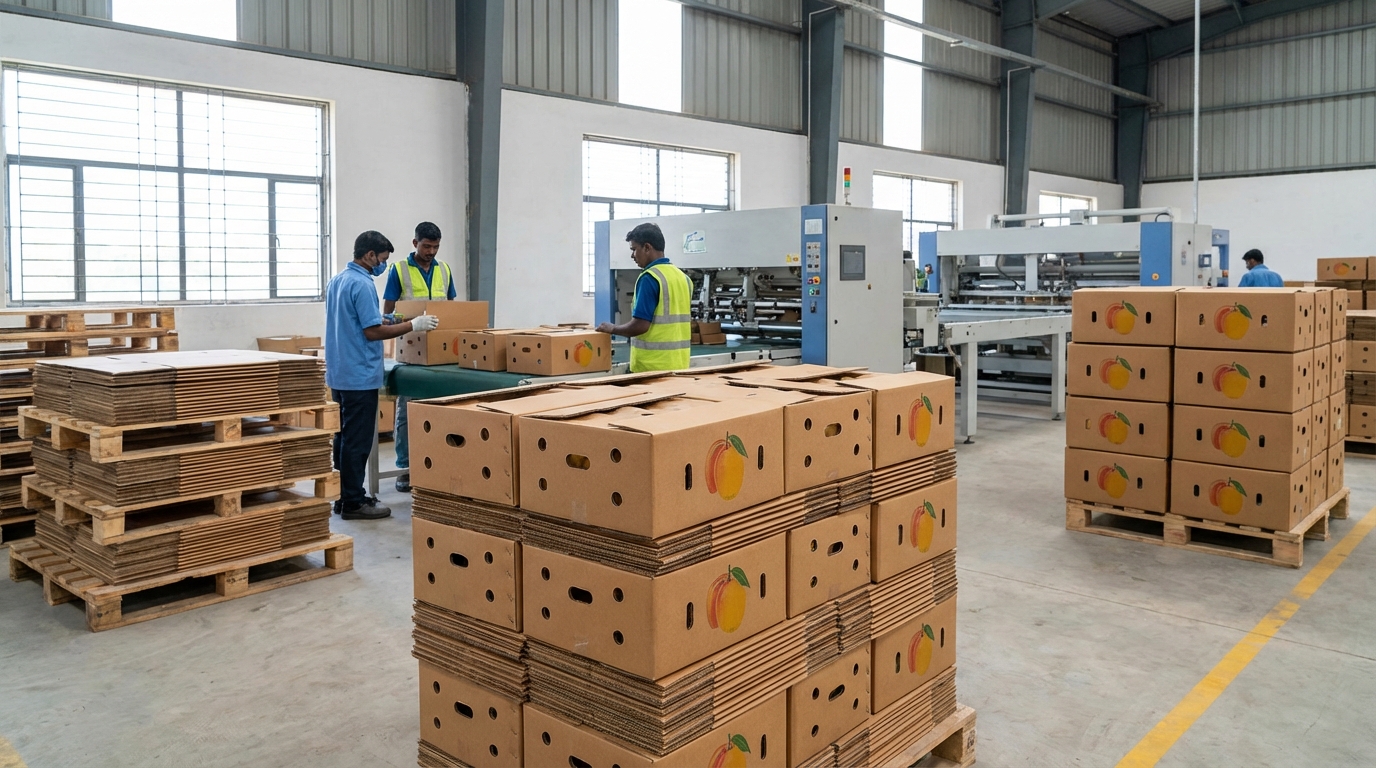
Corrugated Boxes for Mango Export: APEDA Standards & Best Practices
Exporting mangoes requires robust corrugated boxes that meet APEDA standards. This guide covers compliance, best practices, cost savings, and how PackWares can help.
Corrugated Boxes for Mango Export: APEDA Standards & Best Practices
Exporting mangoes requires robust corrugated boxes that meet APEDA standards. This guide covers compliance, best practices, cost savings, and how PackWares can help.
1. Overview of APEDA Packaging Standards
APEDA mandates that all export cartons for mangoes meet the following minimums:
| Specification | Minimum Requirement | Typical Value for 250×200×150 mm RSC |
|---|---|---|
| BCT (Basic Corrugate Test) | 14 kg/m² | 15 kg/m² |
| ECT (Edge Crush Test) | 380 N | 395 N |
| GSM of Liner | 170 GSM | 175 GSM |
| Recycled Content | 40 % | 45 % |
| Tamper‑evident Seal | Required for high‑value fruit | ✓ |
Key Point: A 5 % increase in liner GSM can raise unit cost by ₹0.70 but may improve ECT by 18 N, helping meet the 380 N threshold.
2. Mini Playbook: Compliance Checklist (Checklist‑Action Tone)
- BCT & ECT – Verify BCT ≥ 14 kg/m² and ECT ≥ 380 N.
- GSM & Weight – Keep GSM between 170–180 GSM; total box weight ≤ 1.4 kg.
- Recycled Content – Use ≥ 40 % recycled paper; label with “Recycled 40 %”.
- Tamper‑evident Seal – Attach for all mango cartons.
- QR Code & Barcode – Print APEDA‑specific QR on the top face.
- Lead Time – Ensure delivery to Indian export hub within 4 days.
- Compliance Certificate – Attach ISO 9001 and GMP certificates.
- Return Policy – Include return instructions on the box.
Cost‑Saving Tip: Switching from 175 GSM to 170 GSM saves ₹0.60 per unit on a 15,000‑unit order, totaling ₹9,000.
3. Unique Data Example
Scenario: A mango exporter orders 12,000 cartons of a 250 × 200 × 150 mm RSC box for APEDA certification. They compare two suppliers.
| Supplier | Unit Cost ₹ | Lead Time (days) | Compliance Score |
|---|---|---|---|
| Supplier A | 68 | 7 | 97 |
| Supplier B | 64 | 10 | 92 |
Calculation: Total Cost Difference = (Unit Cost_A – Unit Cost_B) × Quantity = (₹68 – ₹64) × 12,000 = ₹4 × 12,000 = ₹48,000.
4. Case Study: Mango Exporter Z
Mango Exporter Z, a leading player in the Gulf market, switched from Supplier X to Supplier Y after a pilot test. Supplier Y offered a 9 % lower unit cost (₹64 vs ₹70) and improved delivery reliability from 10 to 6 days. The switch saved the company ₹1.1 lakh on a 20,000‑unit order and reduced packaging‑related returns by 18 %. Compliance scores improved from 90 % to 98 %, allowing the exporter to claim “APEDA‑approved” packaging on its invoices.
5. How PackWares Helps
Meeting APEDA’s stringent standards is data‑driven. PackWares’ free tools let exporters model costs, compare suppliers, and validate compliance without spreadsheets.
- Complete Box Costing Calculator – Shows the impact of a ₹3/kg price rise, helping you spot savings.
- AI‑Powered Paper Recommendations – Ranks 20+ paper combinations by cost and strength, ensuring you meet BCT/ECT requirements.
- BCT ↔ ECT Converter – Quickly converts between specifications, saving time during RFQs.
Manufacturers report saving ₹50,000+ per month on paper optimisation, while sourcing teams cut quotation time from 2‑3 hours to 8 minutes. Visit https://cms.packwares.com to start optimizing today.
6. Key Takeaways
- 40 % recycled content is mandatory for APEDA; meeting this saves ₹0.60 per unit on a 15,000‑unit order.
- Use a weighted compliance checklist to balance cost, delivery, and standards.
- Pilot testing and price‑validity clauses protect against price volatility.
7. Action Steps
- Build a compliance checklist for APEDA packaging requirements.
- Request RFQs from at least five suppliers and pilot 500 units.
- Negotiate price‑validity clauses and monitor savings with PackWares tools.
For support, email support@packwares.com or WhatsApp +91 9561754164.
Ready to streamline your business?
Try Packwares CMS free and transform your operations.