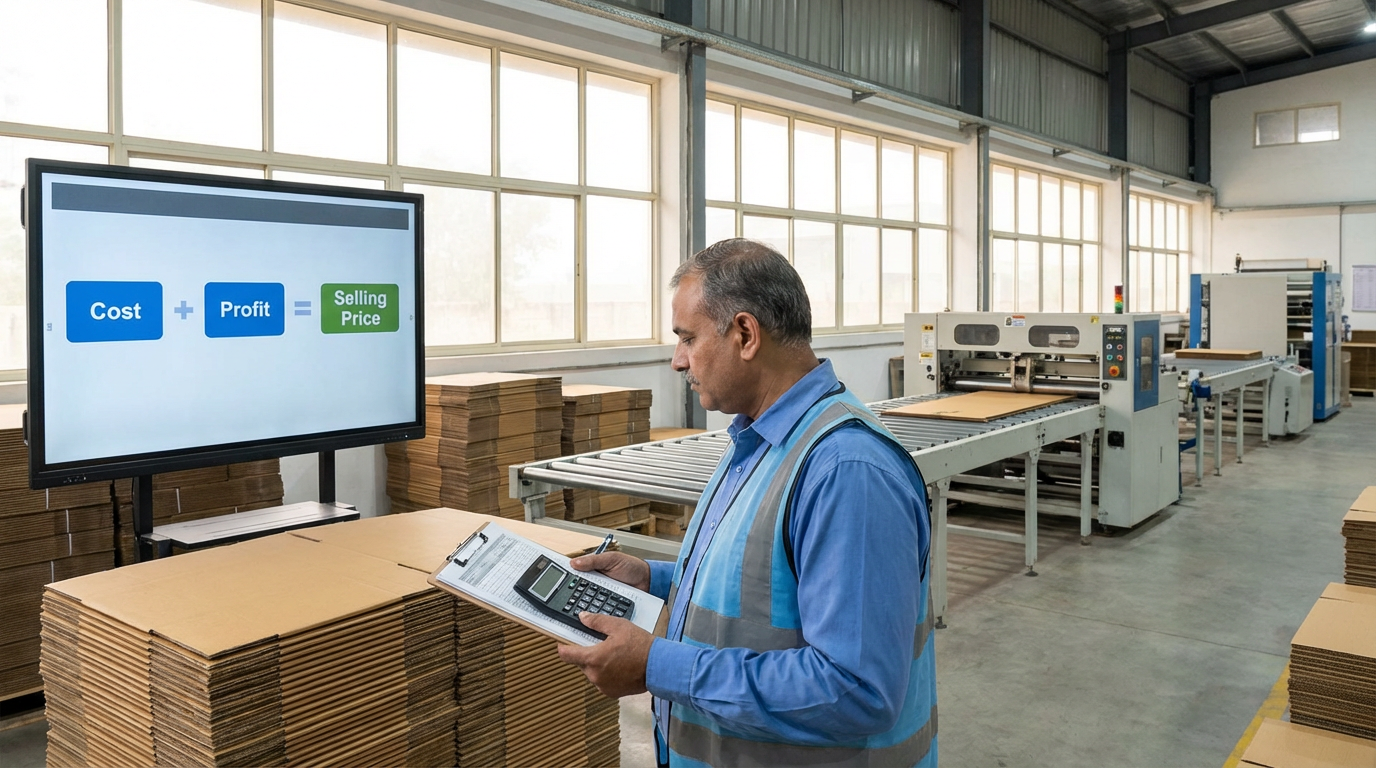
Essential Guide to Corrugated Box Costing and Pricing
Master the fundamentals of box costing—from paper costs to profit margins. Learn how to price competitively without sacrificing profitability.
Accurate costing is the difference between profit and loss in the corrugated box business. A 5% error in costing can turn a profitable order into a loss. This guide covers everything you need to price your boxes correctly.
Understanding the Cost Structure
1. Raw Material Costs (60-70% of total cost)
Paper Costs
The largest component of box manufacturing:
3-Ply Box Example (40cm × 30cm × 25cm):
- Top Liner: Kraft 150 GSM
- Flute: Semi-Chem 120 GSM (B-Flute)
- Bottom Liner: Test Liner 150 GSM
Paper Consumption Formula:
Paper Area (m²) = [(L + W) × 2 + 5cm] × [(W + H) × 2 + 5cm] / 10,000
For 40×30×25 box: 0.495 m²
Calculating Paper Weight:
Total Weight = Area × (GSM₁ + GSM₂ × Take-up Factor + GSM₃) / 1000
Total Weight = 0.495 × (150 + 120×1.5 + 150) / 1000 = 0.238 kg
Adhesive & Consumables (2-3%)
- Starch: ₹0.50 per box
- Ink: ₹0.30 per box (single color)
- Stitching wire: ₹0.20 per box
2. Conversion Costs (20-25%)
Machine Operating Costs
- Electricity: ₹2.50 per box
- Labor: ₹1.50 per box (4 workers/shift)
- Machine Depreciation: ₹1.00 per box
- Maintenance: ₹0.50 per box
3. Overhead & Profit (10-15%)
- Factory Overhead: ₹1.50 per box
- Admin Expenses: ₹0.80 per box
- Target Profit Margin: ₹2.50 per box (15%)
Complete Cost Breakdown
Paper Costs:        ₹10.71 (49%)
Consumables:        ₹1.00  (5%)
Conversion Costs:   ₹5.50  (25%)
Overheads:          ₹2.30  (11%)
Profit Margin:      ₹2.50  (10%)
─────────────────────────────
Total Selling Price: ₹22.01 per box
Common Costing Mistakes
1. Forgetting Wastage
Add 3-5% wastage to paper calculations:
Actual Paper = Theoretical Paper × 1.05
2. Ignoring Flute Take-Up Factor
Flute paper consumption increases based on flute type:
- E-Flute: 1.24× multiplier
- B-Flute: 1.50× multiplier
- C-Flute: 1.43× multiplier
- BC-Flute: 1.36× multiplier
3. Underestimating Small Order Costs
Setup time for orders <1000 boxes adds ₹2-5 per box.
4. Not Tracking Actual Costs
Compare estimated vs. actual costs quarterly to refine your formulas.
Pricing Strategies
1. Cost-Plus Pricing (Most Common)
Selling Price = Total Cost × (1 + Profit %)
Pros: Guaranteed profit margin Cons: May price yourself out of market
2. Market-Based Pricing
Check competitor prices, match or undercut by 5-10%.
3. Value-Based Pricing
Charge premium for:
- Fast turnaround (<48 hours): +15-20%
- Custom printing (3+ colors): +25%
- Small batches: +30-40%
- High BCT requirements: +10%
Volume Discounts
Standard industry practice:
- 1,000-5,000 boxes: Base price
- 5,000-10,000 boxes: -5%
- 10,000-25,000 boxes: -10%
- 25,000+ boxes: -15-18%
Key Takeaways
- Paper costs are 60-70% of total cost—get this right first
- Always include wastage (3-5%) in calculations
- Use correct take-up factors for flute type
- Track actual costs to improve estimates
- Automate costing to eliminate human error
Ready to streamline your business?
Try Packwares CMS free and transform your operations.