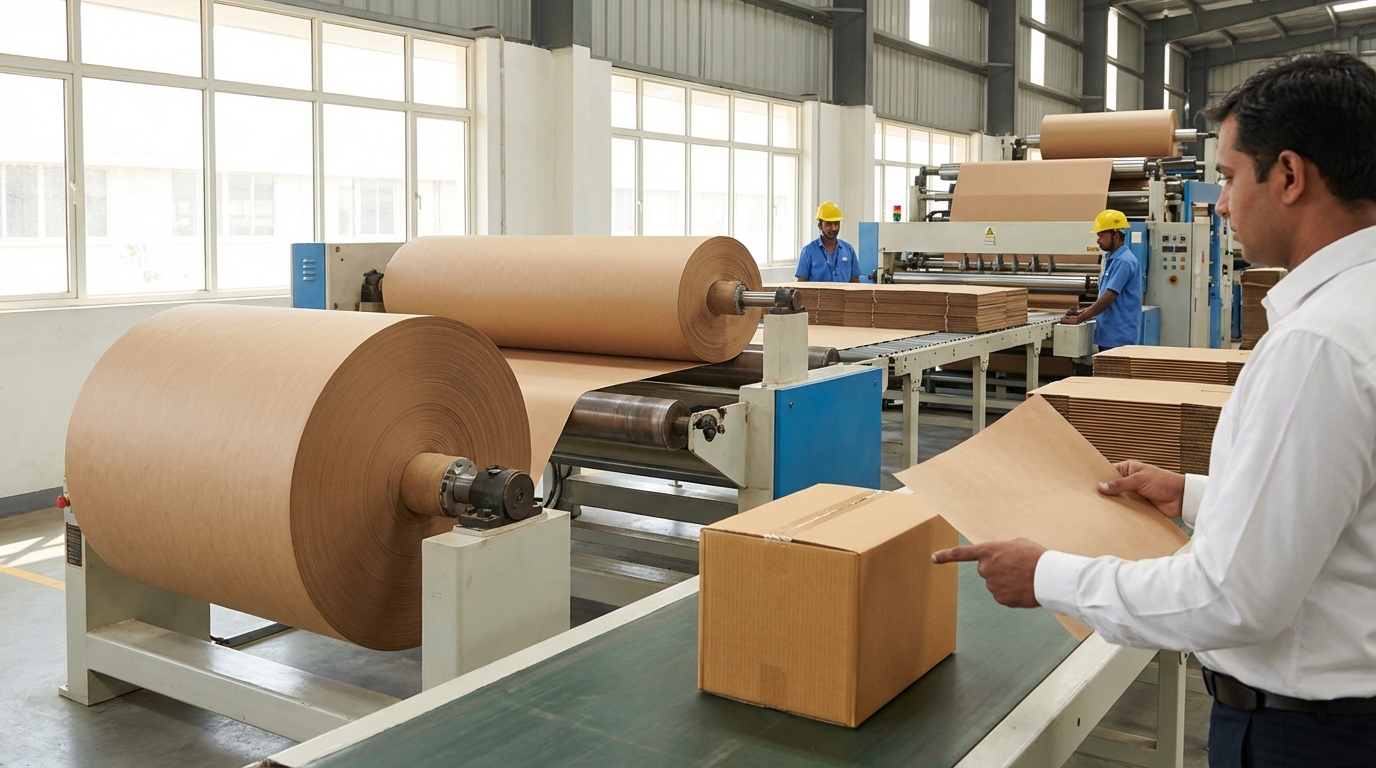
Paper Selection Guide for Corrugated Boxes: Optimizing Strength and Cost
Learn how to select the right paper for corrugated boxes, balancing strength, cost, and sustainability. Practical guide for manufacturers and sourcing teams.
Paper Selection Guide for Corrugated Boxes
Choosing the right paper for corrugated boxes is crucial for balancing cost, strength, and sustainability. With paper costs accounting for 60-70% of total box expenses, understanding paper specifications can save manufacturers and sourcing teams significant costs.
Understanding Corrugated Box Paper Components
Corrugated boxes consist of three main components:
- Linerboard (Top and Bottom): Provides surface for printing and outer strength
- Fluting (Corrugated Medium): Gives the box its compressive strength
- Adhesive: Bonds the fluting to the linerboard
Paper Types and Their Characteristics
| Paper Type | GSM Range | Price Range (₹/kg) | Typical Use |
|---|---|---|---|
| Virgin Kraft Liner | 150-250 | 55-70 | High-strength applications |
| Recycled Test Liner | 120-200 | 42-55 | Cost-effective, sustainable |
| Semi-Chemical Flute | 100-140 | 45-60 | Standard corrugation medium |
Calculating Optimal Paper Selection
Let's consider a practical example for a 400×300×250mm RSC box:
| Component | GSM | Price (₹/kg) | Cost per Box |
|---|---|---|---|
| Top Liner | 150 | 60 | ₹12.50 |
| Flute Medium | 120 | 50 | ₹10.80 |
| Bottom Liner | 150 | 45 | ₹9.00 |
Total Paper Cost: ₹32.30 per box
Calculation: Paper Area = 2 × (Length + Width) × Height + additional flaps = 2 × (0.4 + 0.3) × 0.25 + flaps = 0.175 m² (simplified) Cost = Paper Area × GSM × Price/kg
Case Study: Optimizing for Cost and Strength
A leading FMCG company reduced their packaging costs by 12% by switching from virgin kraft liner to recycled test liner for their secondary packaging. While maintaining the same BCT (Box Compression Test) strength, they saved ₹1.2 lakhs per month on their 1 million box monthly requirement.
How to Optimize Paper Selection
For Manufacturers:
- Use PackWares' AI-Powered Paper Recommendations to find optimal paper combinations
- Consider using different paper grades for top and bottom liners
- Regularly review paper prices and adjust specifications accordingly
For Sourcing Teams:
- Negotiate bulk purchase agreements for consistent paper quality
- Verify supplier paper specifications against actual delivery
- Request samples before placing large orders
Key Takeaways
- Paper selection directly impacts both cost and box strength
- Understanding paper components and their costs is crucial for optimization
- Small changes in paper specification can lead to significant cost savings
Action Steps
- Review your current paper specifications and compare with industry benchmarks
- Use cost calculation tools to determine optimal paper combinations
- Collaborate with suppliers to explore alternative paper options that meet your strength and cost requirements
Visit www.packwares.com to access our free paper optimization tools.
For more information, contact support@packwares.com or WhatsApp +91 9561754164
Ready to streamline your business?
Try Packwares CMS free and transform your operations.