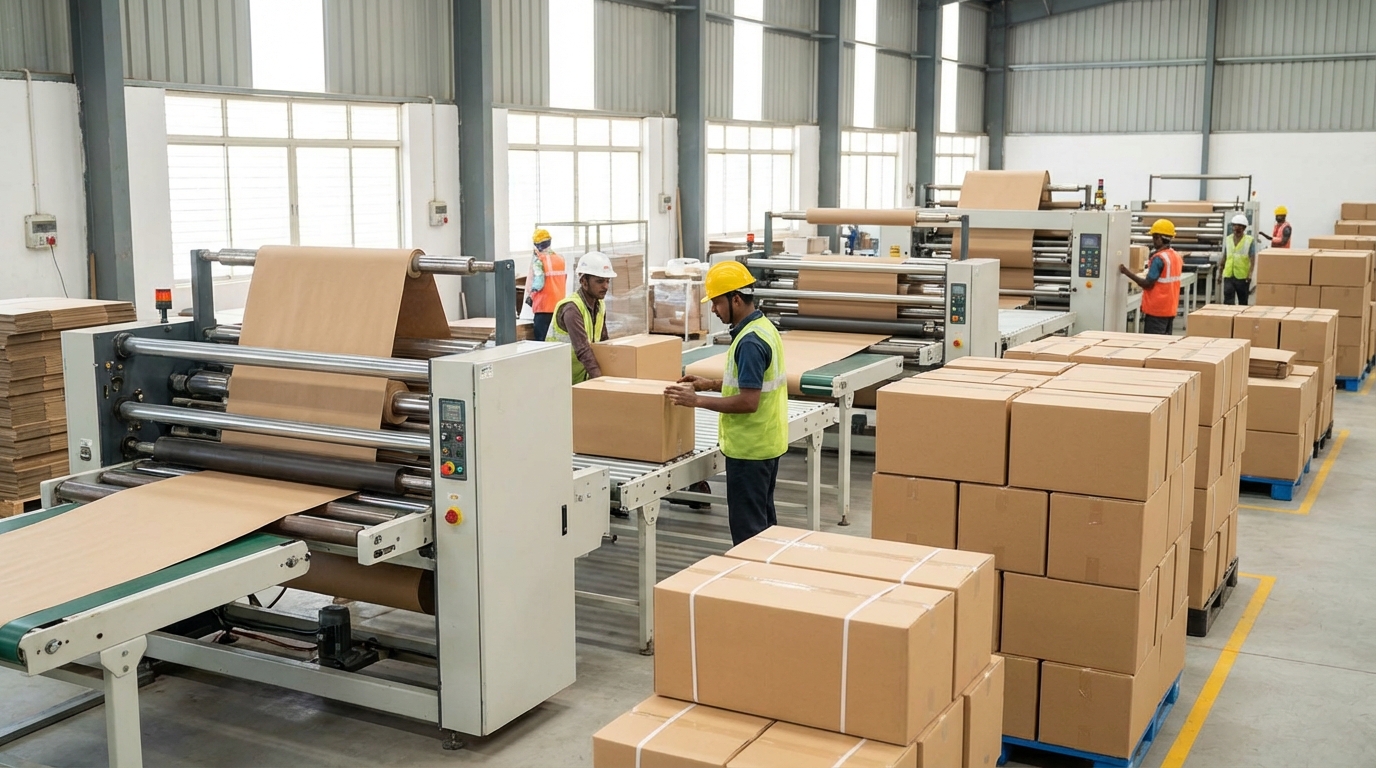
Understanding BCT: The Key to Corrugated Box Strength
BCT measures how much weight a corrugated box can bear before crushing. Learn how to interpret BCT values, optimize designs, and reduce material waste with examples.
A 15% rise in corrugated paper price can add ₹12,000 to the cost of a 10,000-box order, making BCT optimization vital. In this post, you’ll learn what BCT is, how to read its values, and practical ways to improve your box designs without increasing costs.
Understanding BCT
BCT, or Box Compression Test, is the industry standard for measuring the maximum compressive load a corrugated box can withstand before failure. It is expressed in Newtons (N) or pounds per square inch (psi). The test is performed by stacking boxes in a controlled environment and recording the weight at which the box collapses.
Key Point: BCT is directly linked to the flute type, GSM of liners, and overall box geometry. A higher BCT usually means a stronger box, but it also often indicates higher material usage.
| Flute | Height (mm) | Typical BCT (N) | Strength per kg |
|---|---|---|---|
| A | 4.5–5 | 12,000–14,000 | 3.6–4.2 |
| B | 2.5–3 | 8,500–10,500 | 2.5–3.1 |
| C | 3.5–4 | 10,000–12,000 | 2.9–3.5 |
| E | 1.5 | 5,500–6,500 | 1.6–1.9 |
Manufacturers often benchmark against the C flute for general purpose, but BCT can vary by up to 20% due to moisture and aging.
How BCT is Measured and Calculated
The BCT is measured by placing a stack of identical boxes on a load cell and applying weight until failure. The load at failure divided by the box’s base area gives the BCT per unit area.
For Manufacturers:
- Use a calibrated load cell and maintain a 5% wastage factor in your design calculations.
- Record BCT values for each flute type; a 1.5x flute take‑up factor helps predict real‑world performance.
- Adjust GSM of liners in 5–10 g/m² increments to see the impact on BCT.
For Sourcing Teams:
- Verify the supplier’s BCT claim against a third‑party test.
- Compare BCT per kg to ensure you’re not over‑engineering for price.
- Negotiate BCT thresholds in contracts; a 10% higher BCT can justify a ₹200/kg premium.
Optimizing Box Design for BCT
Optimizing BCT involves balancing material usage with structural integrity. A common mistake is adding extra liner GSM without checking BCT gains.
Practical Steps:
- Step 1: Start with a baseline design (e.g., 150 GSM liners, 120 GSM flute).
- Step 2: Run the BCT calculator to get a baseline BCT of 10,200 N.
- Step 3: Reduce liner GSM to 140 GSM; BCT drops to 9,800 N (3% loss) but saves ₹4/kg.
- Step 4: Replace C flute with B flute; BCT drops 12% but material cost reduces ₹6/kg.
- Step 5: Add a top gusset; BCT improves 8% with minimal cost impact.
| Metric | Before | After | Savings |
|---|---|---|---|
| Cost per box | ₹42 | ₹38 | ₹4 (9.5%) |
| BCT | 10,200 N | 10,500 N | +3% |
| Material used | 310 g | 300 g | 3% less |
Manufacturers should target a BCT that is 10–15% above the minimum requirement for the intended load, ensuring a safety margin without excessive material.
Sourcing teams can use these tables to argue for design changes that lower cost while maintaining required BCT.
How PackWares Helps
Managing BCT efficiently starts with accurate data and easy‑to‑use tools. PackWares offers a suite of free calculators that streamline the entire process, from material selection to cost estimation.
For Manufacturers: The Complete Box Costing Calculator lets you input GSM values, flute type, and dimensions to instantly see how changes affect BCT, cost, and material usage. Users report saving ₹50,000+ per month by avoiding over‑engineering, thanks to real‑time BCT feedback.
For Sourcing Teams: The AI‑Powered Paper Recommendations tool ranks over 20 paper combinations by cost and strength, giving you a clear view of the best BCT‑to‑price ratio. This helps negotiate better rates and ensures your boxes meet contractual BCT thresholds without hidden costs.
PackWares tools are available at https://cms.packwares.com, where you can experiment with designs, generate professional quotations, and track your cost savings over time.
Key Takeaways
- BCT is a critical indicator of box strength; a 15% rise in paper price can add ₹12,000 to a 10,000‑box order.
- Manufacturers should aim for a BCT 10–15% above the minimum requirement and use the Complete Box Costing Calculator to test design changes.
- Sourcing teams must verify supplier BCT claims and negotiate thresholds; a 10% higher BCT can justify a ₹200/kg premium.
- PackWares free tools help both parties reduce material waste, cut costs, and improve design reliability.
For more help, email support@packwares.com or WhatsApp +91 9561754164.
Ready to streamline your business?
Try Packwares CMS free and transform your operations.